


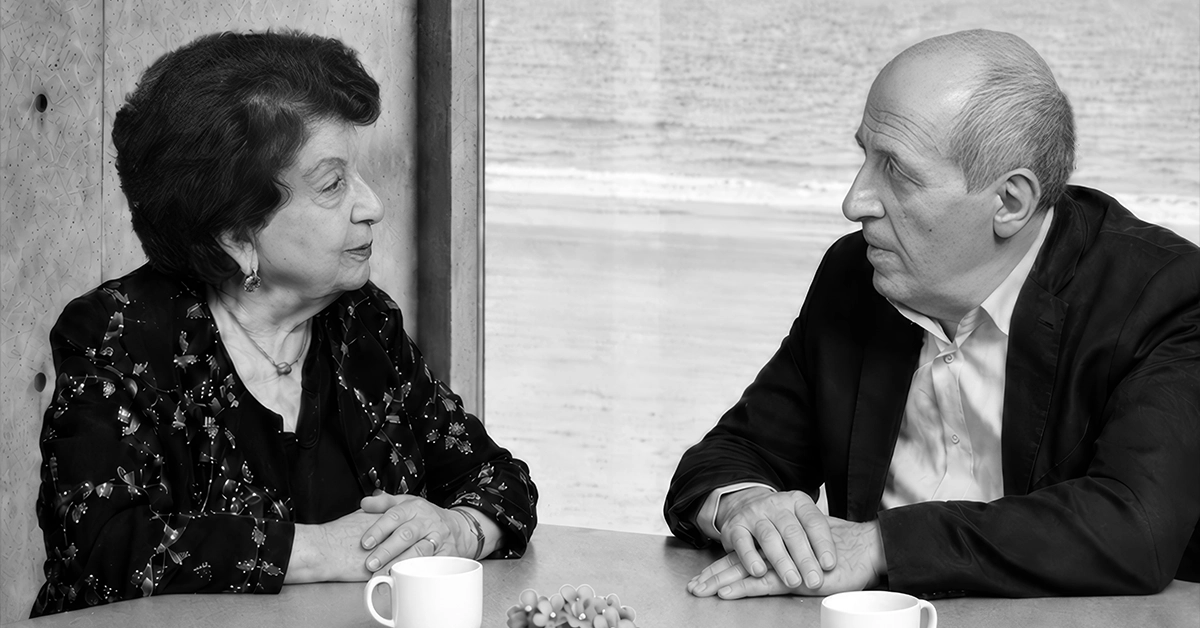
Jenaro Kristesashvili and Levan Kobaladze
Professional Genetics — Does the medical profession pass from parent to child?
Intervewed by Eka Noniashvili
There are doctors for whom medicine is not just a profession; it is a mindset, a daily choice, and a responsibility that does not end with working hours.
The story of Jenaro Kristesashvili and Levan Kobaladze is exactly like this: two generations meeting in one space, although they come to this path from completely different starting points.
Jenaro Kristesashvili, Professor, Doctor of Medical Sciences, geneticist, reproductologist, and gynecologist, one of the founders of reproductive medicine and medical genetics in Georgia, Vice-President of the Georgian Reproductive Association, associate member of the International Academy of Human Reproduction, member of the European Society of Contraception and Reproductive Health, and 4 other Georgian and international professional academies. Chromosomal analysis – karyotyping – was performed and implemented by her for the first time in Georgia.
Her son, Levan Kobaladze, a doctor-sexologist, Doctor of Medicine, Master of Public Administration, continues to work in this space on his own path. Academic experience, multidisciplinary knowledge, and modern approaches allow him to approach medicine from a different angle; however, one of the main influences on this path is still the environment in which he grew up.
It is interesting that there is no pre-written plan behind this professional coincidence. On the contrary, their choices start from different points, and the main question of this story naturally arises:
How much do we choose a profession and how much does it choose us?
Jenaro Kristesashvili: There were no doctors in my family. I studied all subjects equally at school. Cronin’s “The Citadel”, read in the 9th grade, sparked my interest in the medical profession, and I decided to choose this path. As for Levan, I think the best method of upbringing is one’s own example; however, Levan was interested in architecture. I could not see Levan in architecture, since “Soviet architecture” was confined to strict frameworks, and creative self-realization was difficult. Therefore, I believed that he would be better suited to medicine, so I would help him choose a direction. I knew what path he should take to become a good doctor.
Levan Kobaladze: Despite the fact that in our field I am jokingly called “Jenaroevich” (and this is more of a responsibility for me than a “shadow”), I had a high degree of independence. In general, I was interested in everything. I studied well, my mother was an exemplary, strict parent, so much so that my friends still pressed themselves against the wall when she appeared; however, I did not lack freedom. I have been allowed to travel alone more than once and have taken care of myself independently from an early age. I wanted to be an architect. It was the Soviet period, and they said this field had no scope – she made me decide to apply to medical school. I enrolled in the medical faculty, in the final year, I took pediatrics at the department of Professor Irakli Faghava, who made me love and get interested in pediatrics so much that I decided to be a pediatrician. I already loved children very much, and it was an extraordinary school. I got involved with my whole being – I completed my residency and postgraduate studies in pediatrics, and defended my dissertation in this field. During my student years, after the third year, like many of my classmates, I started working as a nurse in the intensive care unit of the Republican Hospital, where the head of the department was Dato Kuchava – an extraordinary doctor, a professional, who taught us young people, in addition to practical skills, love for the patient, clinical and analytical thinking. It was at this time that I realized I had chosen the right profession, and exactly where theory turns into practice, the medical profession begins.
Then came the difficult years, the transitional period of the collapse of the Soviet Union – there were many doctors, few patients, many students, coupon salaries that barely sufficed for transport to get to work… I switched to medical management, graduated from GIPA, and later I had to manage numerous projects in public service and international organizations. In 2010-2012, projects gradually decreased, and I decided to return to the clinic.
And you returned in a completely different direction; this was probably already a thought-out and personal choice?
Levan Kobaladze: Sexology is a complex field; it is on the borderline of all other fields. With a patient, you must consider psychiatry, psychology, urology, neurology, endocrinology, reproductology, andrology, etc. Patient diagnosis and treatment are effective only with a complex approach, which you cannot do without a good academic education. At the same time, it is a rare specialty; there are only 14-15 doctors of this specialty in Georgia. For me, this was a challenge – here is the ball and here is the field, and I have been on this “field” for 15 years already.
I try to find out more about their mother-son relationship, daily routine, and every attempt to talk about personal things masterfully and very naturally shifts to the profession. I give up; this is the most organic topic of this family, and the talk from the past of professional choice slowly moves to what is very important for both of them – how medicine has changed today.
What is the medical profession today — a protocol or a mindset?
Levan Kobaladze: We often discuss various medical histories in the family. Recently, doctors could not diagnose our relative, so my mother and I sat down and discussed the symptoms, anamnesis, and reasoned about the diagnosis based on our general knowledge. We went into details. Today, unfortunately, doctors rely only on instrumental and laboratory examinations, but why is “House M.D.” unique? He is a doctor who relies not only on examinations, but on logic, experience, general knowledge, sometimes non-standard thinking… Today, even abroad, medicine is mostly standardized, and patient management is done only by guidelines.
So, talking about medical topics in the family resembles a consilium?
Jenaro Kristesashvili: It breaks my heart that the culture of the consilium is being lost in our country, yet this was exactly what the Georgian medical school was famous and strong for, protocol and guideline are necessary, but they are built on one specific diagnosis, while the patient often has multiple concomitant diseases, here general medical education and knowledge help you, as well as discussing the history together with doctors of adjacent profiles.
Levan Kobaladze: The consilium has also been lost, as well as clinical thinking. The importance of general medical education is invaluable. If you do not have a solid academic foundation, you cannot be a doctor. Clinical thinking comes from the basis; both of us have this basic knowledge, which allows us to see this or that patient from a broader spectrum rather than from a narrow profile.
How simple is it to live together in such an academic environment, and who learns from whom?
Levan Kobaladze: All of Georgia learns from her and, of course, me too; even in everyday life, despite her older age, she is so capable regarding novelties that she will give many young people a run for their money even in this digital era. She was over 60 when she fully mastered modern computer technologies, she learned English by herself to the point that she writes articles and reports fluently, and sometimes even professional linguists have her correct English texts or translations. When we ask her what the secret of her youth is, she answers professionally, genetics, but, I think, along with this, working and interacting with young people. 33 doctors defended their dissertations under her supervision. This is not simple; it is the hardest work. She works for months together with the doctoral candidates. She is a perfectionist and demands the same from them. In parallel, she teaches students at I. Javakhishvili State University, where she is not only a professor, but a mentor, an educator, and a pathfinder.
Now I am talking to doctors of two generations, you also work with doctors of the younger generation, what has changed the most in this field? Technology or the doctor’s mindset?
Jenaro Kristesashvili: Technologically, everything has moved forward. When we were starting, there were fewer possibilities, and therefore, we used our brains more. Today, a doctor has a wide spectrum of instrumental and laboratory examinations and relies on their results. This is good, but I emphasize that a doctor must think academically, not be dependent only on external factors. Today, there is commercialization in medicine in large doses; a doctor has to compromise, and a line must be drawn between the needs of the patient and commercial interests. In my clinic, I have the luxury to distance myself from this; my authority gives me the opportunity to stay away from commercialization.
Levan Kobaladze: A doctor today is no longer just a healer; he is a manager, an administrator, an influencer, a marketer, because income often depends on the number of patients. In our business, professional freedom is important; a doctor’s remuneration should not be tied only to the number of patients, which puts him under financial pressure, and this reflects both on the quality of service and on the freedom of the doctor’s clinical thinking. Today, Georgian medicine is not properly appreciated; patients often run abroad for treatment, while the level of medicine in Georgia is very high. Especially in the field of reproductive medicine. For example, just a few months ago, a medical case presented in our article published in a highly rated US journal has been described only 3-4 times in the world. We often surprise the world with Georgian achievements; we have amazing results, and with such results, a doctor should not have to compromise.
Two generations, two different professional realities; however, common values that do not change despite time, and against the background of all this, the question naturally arises:
What do the doctor mother and son appreciate most in each other?
Levan Kobaladze: I appreciate the most important thing, besides the fact that she gave me life, her professionalism, and her form of relationship with patients, students, and colleagues. I cannot win in this marathon, nor do I have any attempt to do so; her attitude towards people is without competition.
Jenaro Kristesashvili: He is boundlessly caring. We live together, my son, his wife, and his child. My daughter-in-law cannot imagine life without me, because I accepted her like a child, and it has been like that to this day.
In this family model, relationships do not stand on a strict hierarchy; on the contrary, respect for each other’s space is clearly felt here. Levan explains this harmony in his own way, with a kind of humor:
Levan Kobaladze: You know how they say the reason for the famous conflict between daughter-in-law and mother-in-law is that two women cannot stand being in one kitchen; in our house, neither of them is in the kitchen, and that is why my mother and my wife have such a harmonious relationship. We have a lady who helps us and, if necessary, the chef in the family is me.
This one phrase seems to briefly summarize their relationship; roles are distributed not stereotypically, but by agreement and comfort. And the main thing – there is no competition in this story, nor a shadow that suffocates. Here is a continuation of the profession, thinking, and values that pass from one generation to another and lay the foundation for the knowledge and academic thinking of future generations.