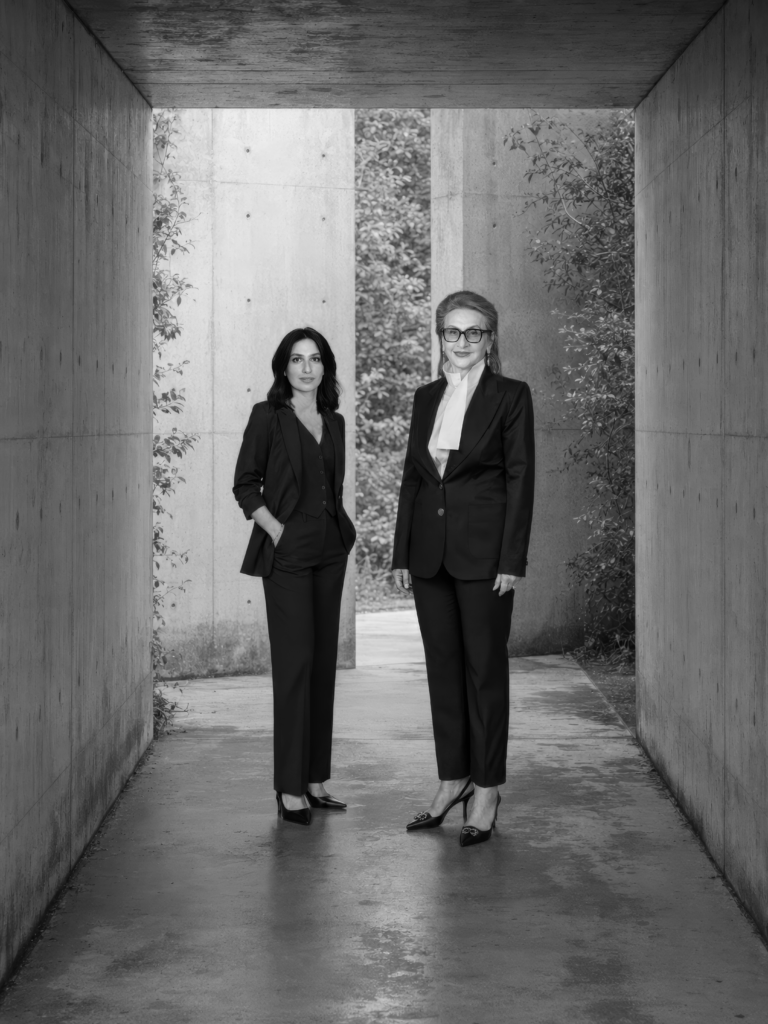


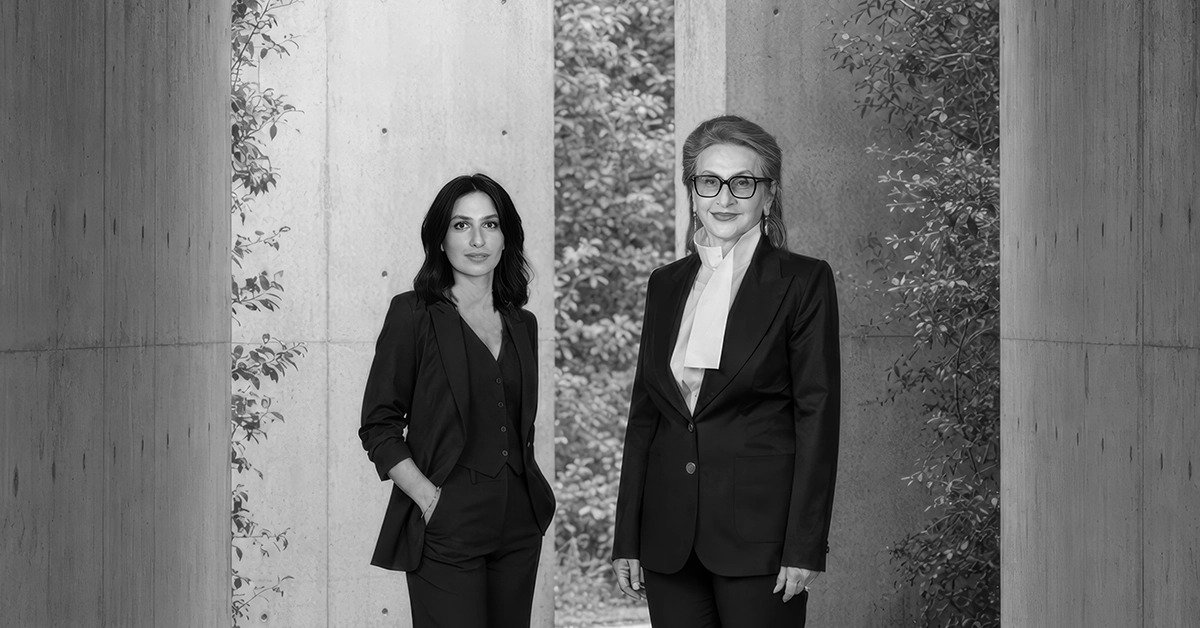
Madona and Bela Jugheli
One Space, Two Paths — The Found and the Seeking
Intervewed by Eka Noniashvili
A profession is sometimes a choice, and sometimes an environment that imperceptibly becomes part of everyday life and ultimately determines the future.
In the story of Madona and Bela Jugheli, the line between choice and influence is almost erased. Here, medicine begins at home, from childhood, from the environment, and from the people you grow up with. Eventually, it turns into a space where one person already stands firmly in her place, with clarity and well-deserved authority, while the other moves within that same space, driven by questions and the search for her own identity.
Madona Jugheli: Gynecologist, reproductologist, Academic Doctor of Medicine, President of the Georgian Colposcopy Federation, international expert-trainer, and certified practicing physician in gynecological endocrinology with 35 years of experience. She belongs to the generation of doctors who built their careers through their own efforts, tough experiences, and relentless hard work. As she says, medicine for her has never been just a job; it is a way of living with love that continues alongside the patient—at home, in her thoughts, and even in her sleep.
Bela Jugheli: Certified obstetrician-gynecologist, international trainer, and participant in the editorial fellowship program of the International Journal of Gynecological Cancer. Bela grew up in an environment where medicine was an everyday reality, the main topic of conversation, the natural rhythm of life, and her mother…
The details of the interview were coordinated with Bela. It was difficult, but she managed to pull Ms. Madona away from her workspace at the end of the workday. However, you won’t find the answer to the question of when Madona Jugheli’s work ends, and her family begins in this interview, either — an interview during which Madona was more present with her patients (over the phone) than with us. For this reason, the active respondent of this interview is Bela Jugheli, while Ms. Madona is the doctor who is always on the line, listening attentively to both her patients and her children.
Our “introduction” extended well into the interview, and towards the end of our meeting, I asked the main question:
And yet, do we choose the profession, or does it choose us?
Madona Jugheli: None of my answers will be exact; it was everything all at once: family, environment, the desire to emulate, and difficult experiences too.
My mother worked at the Ministry of Health, my brother was a gynecologist, and I spent a lot of time with my grandmother, surrounded by doctors. Before me, my older brother, Seva, became a doctor; I was practically raised by him. He was one of the young gynecologists at the Chachava Clinic, and even though he later went into diplomacy, he left a huge mark on my future. But the most emotional impact came from my great-grandmother’s story — she died of cervical cancer, though the diagnosis was never fully confirmed. This always troubled me, and at the same time, I always loved exactly this: unraveling unsolved mysteries, which is what I built my entire professional career upon.
Bela Jugheli: I don’t have a straightforward answer to why I became a doctor either, because I, too, grew up in such an environment — a world full of doctors: doctor friends, doctor colleagues, doctor relatives, family, and other events, and holidays spent with doctors. From the age of ten, I attended conferences with my mother. Her friends became my circle. For a long time, I thought being a doctor was my choice. Now I say it was the environment that convinced me I could be just as good at this as my mother, Madona Jugheli.
I am a rebel by nature; no one can force me to do something that isn’t organic to me, which is why I think this is an interesting case. There was no pressure, but there was the environment and a personal example. There simply was no other reality, no other profession. My mother was everything to me, and maybe that’s why I embraced this path as if it were my own.
Bela belongs to that rebellious generation that has no trouble asking open questions and gives you the courage to ask her directly:
In this profession, is being Madona Jugheli’s daughter a shadow or a motivation?
Bela Jugheli: First and foremost, it is a source of pride for me. I have one mother, and she is Madona Jugheli. I have never had a complex about it. On the contrary, it’s a benefit. I won’t hide it, there was a time when I wanted to prove that I achieved everything on my own. But then I realized I have nothing to prove to anyone. I have the unique opportunity to learn from Madona Jugheli continuously and generously. However, I am currently in a phase of transformation. I want to understand exactly whether this is my choice or the influence of my environment. I won’t betray medicine because I know nothing better than this, and I wouldn’t be able to accumulate such a wealth of knowledge in another field; plus, I absolutely love female biology in medicine, so I will stay in gynecology. But in what specific direction — I am still thinking about that.
We talked a lot more about this topic. Trying to bring Madona back into the interview, I wanted to learn more about their colleague/mother-daughter relationship and where the line is drawn between parent and colleague.
Is it difficult to leave space for your child when you yourself have such a strong influence?
Madona Jugheli: I’ve often wondered if I got in my children’s way. Was my influence too much? There was a moment when I said I should “step back” and leave them more space. However, this “stepping back” doesn’t mean leaving the profession, but rather returning to myself. It’s not just a factor with Bela; apparently, my “excessive” protectiveness applied to Kote, my older son, as well. Like Bela, he is also in a transformation phase, though I share the same attachment with him as I do with Bela. When I come home from work in the evening, I always call him; he has great analytical thinking and evaluates everything correctly — he sorts things out and gives you an absolutely accurate analysis. Despite this attachment to my children, I decided to give them more space. There was a small turning point, and now I listen to myself more. I interfere less in their lives and devote more time to medicine — learning, developing, and introducing new things.
Bela Jugheli: In reality, Madona couldn’t quite pull that off; she is an infinitely caring mother. An irresistible gravity connects the three of us. For me, my brother, who is 10 years older, was the ideal man; he controlled everything with me, but my mother didn’t have the same influence on Kote as she did on me. I was with Madona full-time. She had a deficit of time, so I was constantly adapting to her free moments. When I went to sleep at night, I had a fear of losing her; I would run a fever if she was away for a few days — my body demanded it, I needed to be close to her in every possible way…
Bela, however, did manage it, and today she is also her mother’s colleague. They even spend their working hours in the same space. Yet, as she says, this still isn’t quite what satisfies her. She is in a process of searching. Being a doctor is a proud, desirable, interesting, and beloved profession for her, but in this search, one feeling stands out in particular:
Bela Jugheli: For my age, I think I’ve achieved a lot — as Madona’s daughter, through my own efforts, and by utilizing every opportunity. I completed my residency, participated in the fellowship of an American journal, I am a speaker at high-level international conferences, I got my license, gave birth to two children while studying, and I even had an office opened for me. I love working with patients, and if I have a question, Madona is right there… Despite all this, I am fully dependent financially on my mother and my husband. A good doctor in Georgia isn’t financially secure right away; it takes years to achieve that. Madona is still at the clinic until 11 PM today; she is a coach, a doctor, living her profession entirely… I love being a doctor, but I also want to have my own life. I want to be a doctor like Madona, but not at the price it cost her. That’s why I am thinking of directing my skills and knowledge toward something that will bring more income — finding the right path to use what I already know well, doing what I love, being useful, and being decently compensated…
The experienced Madona Jugheli listens to the searching, rebellious, and determined young doctor calmly and thoughtfully, and returns to the dialogue like this:
Madona Jugheli: Bela is a very good doctor with great foundational knowledge. She already catches details that I couldn’t notice at her age. She has analytical thinking, studies the patient in depth, and listens. She often criticizes me for my time management, while she herself listens to a patient for hours. Such a doctor is rare today. That is why it breaks my heart that she might detour from this field…
Bela Jugheli: To me, a good doctor is Madona Jugheli — with vast medical knowledge and experience, who loves the patient, approaches everyone individually, and is empathetic and compassionate. Despite her scale, she is very simple and approachable. She is constantly growing, learning, listening to others, never stopping — and alongside all this, she is a very good mother. I don’t know if it’s the “right” kind of motherhood, but she is a hyper-caring mother who devotes all her resources to her children and grandchildren. Despite my skills and capabilities, I will never be Madona Jugheli, but I can properly take care of this resource. My dream is to open a clinic where Madona will be happily and fully realized.
Toward the end, the young colleague’s goal became clear. She says that the great resource Madona Jugheli possesses must absolutely continue, “whether in me or someone else, we’ll see” — perhaps it is precisely within this uncertain yet very clear direction that her own path is being born.
Madona and Bela Jugheli — mother and daughter, drawn together with immense gravity, yet moving at different paces and with different questions. They are united by one space where the core value remains unchanged: love for people.
And it is precisely in the different forms of realizing this love that their differences emerge: one already stands where the profession has become a way of life, while the other is in that same space, searching for her own place.